
The Future of Intelligent Robotics Artificial Intelligence has transformed the way organisations create, analyse and automate information.
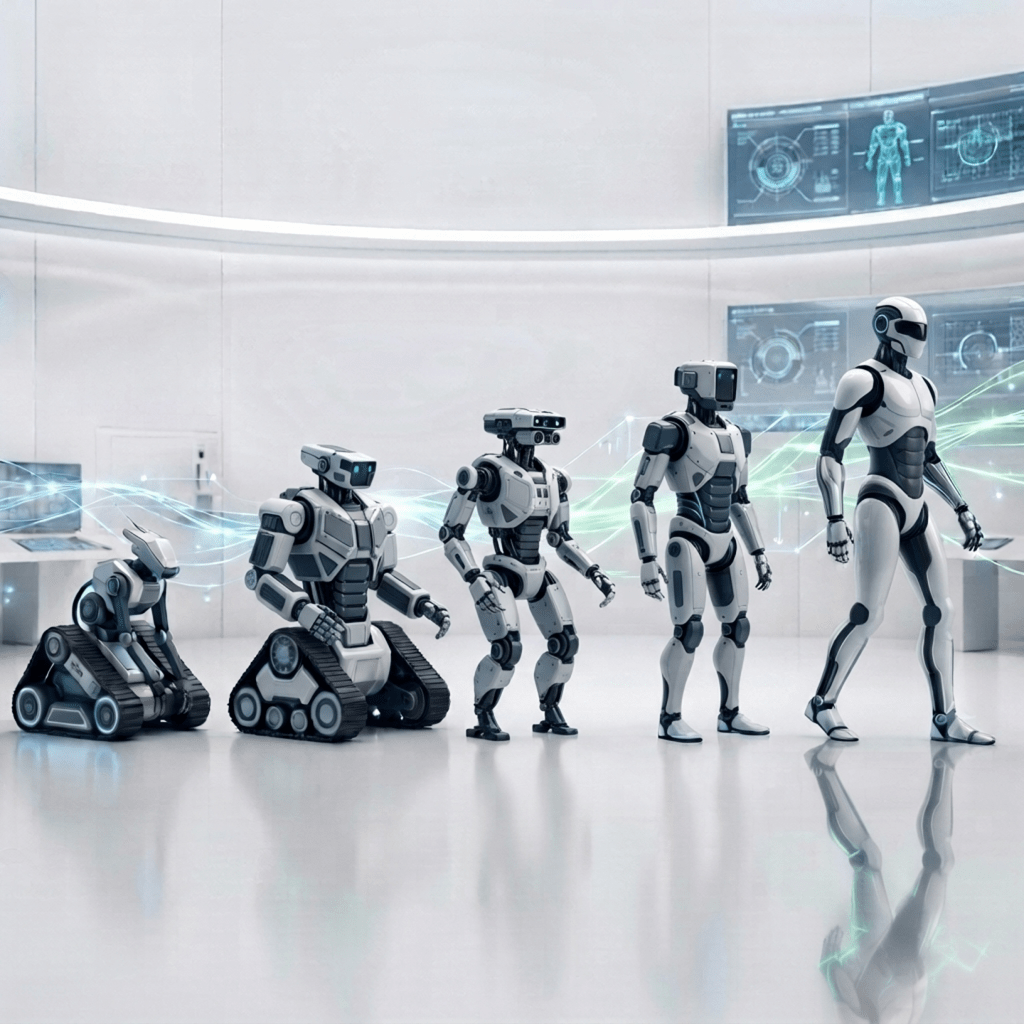
Powered by breakthroughs in Generative AI, Large Language Models (LLMs), computer vision and multi-modal AI, today’s humanoid robots can understand natural language, learn from observation, interact with people, and perform increasingly complex tasks with intelligence and precision.
This represents a significant shift in how organisations will operate, enabling businesses to automate repetitive and labour-intensive activities while allowing people to focus on higher-value work.
Intelligent Learning Through AI
Modern humanoid robots are no longer programmed for a single task. They continuously learn by combining artificial intelligence, computer vision, sensor technology and natural language understanding.
Through observation, simulation and real-world experience, robots can rapidly acquire new capabilities, adapt to changing environments and improve performance over time.
As AI models continue to evolve, humanoid robots become increasingly intelligent, versatile and commercially valuable across multiple industries.
Collective Intelligence
The next generation of robotics is built on connected intelligence.
Rather than learning in isolation, humanoid robots can securely share knowledge through cloud platforms, enabling improvements made by one robot to benefit an entire fleet. This collaborative learning approach accelerates innovation, improves operational performance and significantly reduces deployment times.
The result is a continuously evolving workforce that becomes smarter, more capable and more efficient with every interaction.
Addressing Tomorrow’s Workforce Challenges
Across the world, organisations are facing increasing labour shortages, ageing populations and growing demands for productivity.
Humanoid robotics provides a practical solution by supporting employees with repetitive, physically demanding and precision-based tasks while improving operational efficiency, safety and business resilience.
From manufacturing and logistics to healthcare, retail and professional services, intelligent robotics is rapidly becoming a strategic business advantage.
Why Humanoid Robotics?
The world has been designed for people. Buildings, tools, equipment and workplaces all assume a human form.
Humanoid robots are uniquely positioned to operate within these existing environments without requiring extensive redesign or costly infrastructure changes. Their human-like form enables them to use familiar tools, navigate complex spaces and perform a diverse range of tasks that traditional industrial robots cannot.
Combined with advanced artificial intelligence, humanoid robots offer the flexibility, adaptability and cognitive capability required for modern organisations.
Key Benefits
• Seamlessly integrate into existing human environments
• Perform multiple tasks through a modular and adaptable platform
• Work safely alongside people in collaborative environments
• Utilise existing tools, equipment and workflows
• Automate repetitive, hazardous and precision-based activities
• Reduce labour dependency and improve operational resilience
• Adapt quickly to new tasks through AI-driven learning
• Improve productivity, consistency and quality
• Scale rapidly across multiple business functions
• Support digital transformation and intelligent automation initiatives
COMMUNIK8 provides strategic consultancy to help organisations evaluate, adopt and integrate advanced modular humanoid robotics into their operations.
From business case development and technology selection through to systems integration, manufacturing, deployment and long-term optimisation, we help organisations implement intelligent robotic solutions that deliver measurable business value while enhancing human capability.
The future of work is not about replacing people, it’s about enhancing human capability through intelligent collaboration between people, artificial intelligence and advanced humanoid robotics.
At COMMUNIK8, we call this “Human-to-Machine Collaboration”